


What the market does well
Marikiti and Wakulima are the heart of Nairobi's fresh produce trade, and they deserve their reputation. The markets are busy, full of culture, and run by traders with years of experience who know their produce better than anyone. You see what you buy, you can bargain, and on a good day you leave with a good price.
So the question is not whether the market is good or bad. It is what a kilo you can actually cook really costs your kitchen, once everything is counted.
What the price at the stall leaves out
| Factor | At the market | Why it matters to a kitchen |
|---|---|---|
| Price | Often around 10% lower, and it changes week to week | Hard to cost a menu on a price you only learn on the morning you buy. |
| Quality | Shifts every week and is not guaranteed | A good sack one week says little about the next. |
| Handling | Sacks are thrown, stacked and carried roughly | Bruised and crushed produce looks fine on the day and spoils quickly after. |
| Hygiene | Produce is handled on the ground and in the open | More washing and sorting before it reaches the kitchen, and more risk. |
| Time | An early start, the trip there and back, and sorting afterwards | A staff member's morning, every time you buy. |
| Mobilisation | You need people, transport and cash ready | The run depends on the right person being free on the day. |
| Credit | Cash or M-Pesa on the day, no credit lines | Money leaves the business before the food is sold. |
| Brokers | Middlemen who stand between you and the trader | They add a cut, and you are further from the person who knows the stock. |
A real example: the 90 kg sack of potatoes
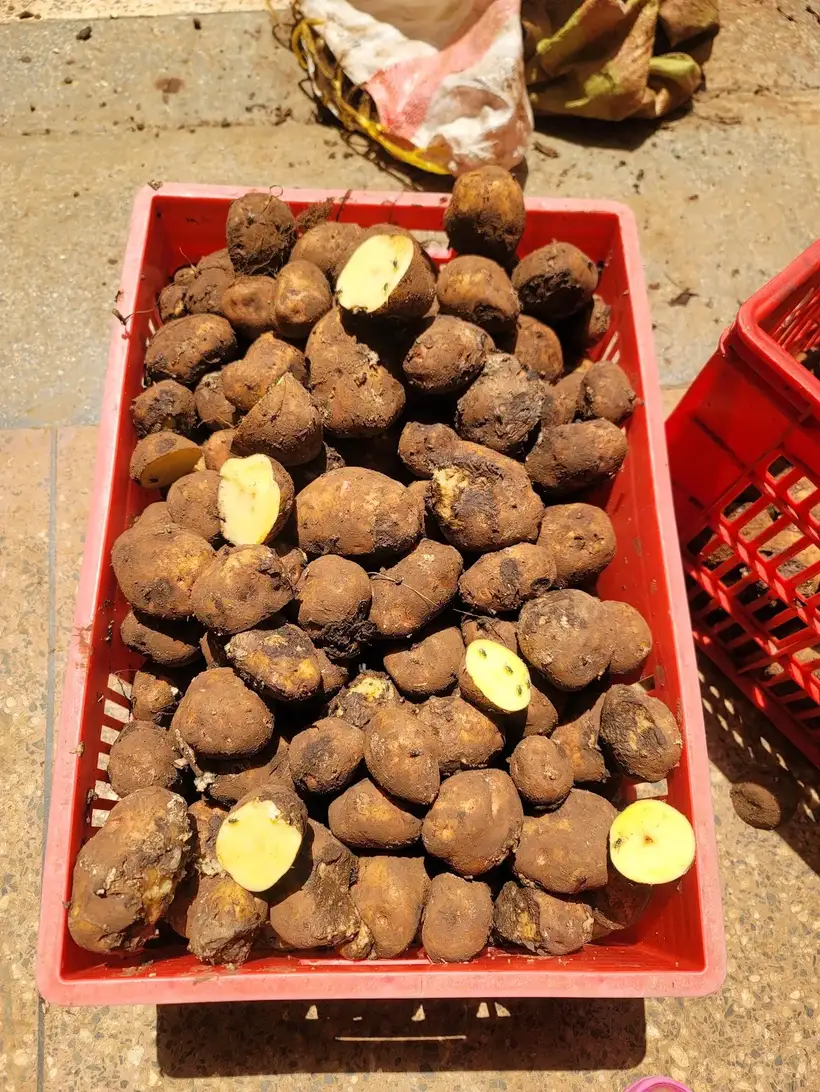
One of the kitchens we work with bought a 90 kg sack of potatoes at the market for KSh 4,500. That is KSh 50 a kilo, and it looked like a win.
Then the sack was opened. About half the potatoes were unusable. Another share were tiny, the size farmers keep as seed (mbegu), which are slow to peel and give little usable potato. Others were mouldy. Out of 90 kg, the kitchen could use 27 kg.
| What it looked like | What it really was | |
|---|---|---|
| Paid | KSh 4,500 | KSh 4,500 |
| Kilos | 90 kg | 27 kg usable |
| Cost per kilo | KSh 50 | About KSh 167 per usable kilo |
For comparison, potatoes were KSh 85 a kilo on the Wapishi price list for the week of 10 November 2026. The other 63 kg went in the bin, which is the part that hurts most: food that was grown, harvested, transported and paid for, then thrown away. Cutting that waste is a large part of why Wapishi exists.
How to work out the real cost
- Weigh what you can use. After sorting and prep, weigh the usable produce from a market buy, not the sack.
- Divide what you paid by the usable kilos. KSh 4,500 ÷ 27 kg is about KSh 167 a kilo.
- Add the run. Transport, fares and the hours of the person who went, divided across what you bought.
- Do the same for your supplier on the same items for two weeks, using the receiving checklist.
- Compare the cost per usable kilo, not the price per kilo. That is the number that reaches your food cost.
If you do buy at the market
- Build a relationship with a few traders and buy from the same ones each time. Good traders look after regular customers.
- Look out for brokers. Deal with the person who owns the stock, not someone offering to get you a better deal.
- Open the sack and look at the bottom. The top layer is the best layer.
- Check the size. A sack padded with mbegu potatoes or undersized onions weighs the same and gives you far less.
- Smell and squeeze. Mould and soft rot often show by smell before you see them.
- Weigh before you pay, and move produce in crates rather than piled sacks so it is not crushed on the way.
- Buy the hardy items there, if anything. Delicate produce such as greens, herbs, tomatoes and ripe fruit suffers most from rough handling.
Where Wapishi fits
Wapishi was built for kitchens that want the market's produce without the market run. You can see this week's prices on the price list and order in the online shop, priced per kilo, bunch or piece, for example potatoes, tomatoes and onions.
- Delivered to 14 areas in and around Nairobi at a time agreed with your kitchen, with early-morning and night deliveries on request.
- On account for qualified partners: 30-day terms with Wapishi Wallet. See kitchen credit.
- eTIMS invoices for every order, and a minimum order of KSh 5,000.
- Try us first with a free sample pack: WhatsApp 0769 912 227.